
Reevaluating board composition

Reevaluating board composition: The case for generalist leadership in global corporate governance
“Don’t fill the Ark—Staff the bridge”In an era marked by volatility, uncertainty, complexity, and ambiguity (VUCA), the effectiveness of a corporate board depends not only on the technical depth of its members but on the breadth of their strategic and leadership capabilities. This short article argues for a recalibration of how boards are composed, particularly in global corporations. It contends that the trend of appointing domain-specific experts to the board —a model likened here to a “Noah’s Ark” of paired expertise — is increasingly ineffective. Instead, the most resilient and high-functioning boards are those led by generalist leaders: former CEOs, senior executives, and operational general managers with a track record of strategic oversight and people leadership. I propose a hybrid model that favors generalist board composition, supplemented by specialist consultants as needed, thus maintaining the board’s strategic integrity while ensuring subject matter rigor.
1. Introduction: The “Noah’s Ark” problem in boardrooms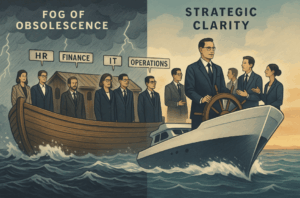
Across many global boardrooms today, a familiar pattern has taken hold — a structure that mirrors the biblical Noah’s Ark. For every critical domain, boards are stacking two-by-two: two cybersecurity experts, two marketing authorities, two finance veterans, two talent gurus, et cetera. The intent is risk mitigation and representation, ensuring every discipline has a voice. Yet this Noah’s Ark strategy, while symbolically complete, is strategically flawed.
Rather than charting a bold course, these boards often resemble floating zoos of expertise, where directors are isolated by often outdated specialty and overly deferential to their functional peers. As each pair narrows its focus to its specific discipline, the board risks losing the cross-functional integration and strategic oversight essential to corporate governance. This leads to fragmented accountability, outdated expertise, and authority bias – quite often to the advantage and/or burden of/on the chairperson.
Sydney (2020) critiques this model explicitly: “Generalists — rather than specialists—make for great board directors… to be better prepared to govern in times of uncertainty.” The problem is not that specialists lack value; it’s that the permanence of their seat on the board can create intellectual silos and stagnation.
The academic literature supports this observation. Nili and Shapira (2024) note in the Yale Journal on Regulation that appointing specialists may in fact reduce the diversity and quality of strategic debate. “Authority bias leads to suppression of diverse viewpoints,” they argue, “particularly when the specialist has been recruited under the premise of exclusivity of knowledge.”
The alternative is to rethink the Ark: not as a static collection of experts, but as a vessel guided by navigators — generalist leaders who can synthesise, question, and direct. These are individuals who have operated companies, not just departments. Who have balanced growth and risk, not just analysed it. Who bring perspective, not just credentials.
In this paper, I argue that the future of corporate governance lies not in Noah’s Ark duplication of expertise, but in empowering generalist captains who can integrate functional insights and steer with strategic clarity. Functional experts should remain part of the picture—as consultants, advisory panellists, or rotating guest participants—but not permanent fixtures at the helm.
2. The limitations of specialist-dominated boards2.1 Obsolescence of expertiseExpertise, particularly in rapidly evolving fields such as cybersecurity or digital marketing, has a half-life. A director whose reputation is grounded in their achievements from a decade ago may no longer be equipped to handle contemporary challenges in that domain. As Sydney (2020) remarks, “Expertise earned in the past can easily become obsolete when not continually tested in real-time environments.”
Nili and Shapira (2024) found that directors labelled as specialists often experience a depreciation of influence over time, especially when their technical knowledge fails to align with emerging trends or technologies. In effect, these directors may inadvertently become liabilities rather than assets.
2.2 Authority bias and groupthinkWhen boards rely heavily on domain specialists, they risk developing a cognitive dependency on those individuals, leading to authority bias. This creates a boardroom dynamic where certain directors dominate conversations within their area of specialty, and other members hesitate to challenge or even question their inputs.
As Nili and Shapira (2024) note, “Authority bias leads to suppression of diverse viewpoints, particularly when the specialist has been recruited under the premise of exclusivity of knowledge.”
This contributes to groupthink which might hinder the board’s ability to critically evaluate, discuss and challenge strategic decisions from a multi-dimensional perspective.
2.3 Fragmented oversight and responsibility silosA board composed of function-specific experts risks devolving into a confederation of silos. Each director may focus narrowly on their area, resulting in an aggregation of perspectives rather than an integrated strategic vision. This is antithetical to the purpose of a board, which is to provide overarching governance and align on long-term value creation.
Moreover, these silos can lead to poor communication and accountability. For instance, cybersecurity may be deemed “handled” because a former CISO is on the board, but this individual may not be aligned with current best practices or may fail to integrate the issue into a broader risk framework.
2.4 Firms exemplifying the “Noah’s Ark-like” board compositionAccording to my framework evaluation, the following companies have (had) boards predominantly composed of domain-specific experts, which may lead to fragmented oversight and a lack of cohesive strategic direction:
- Credit Suisse Group AG
Close